File I/O and Array Lists Example
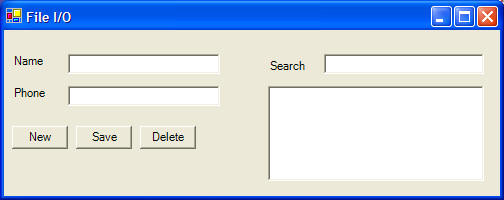
These instructions will build an example program that looks like this:
The new button creates an empty record. The save button will update the current record being viewed. The delete button will remove the current record being viewed. You can search for records by typing a person's name in the Search box; the results are shown dynamically while the user types in a search word.
 |
Download the code by clicking on the Zip file. |
Instructions for Creating the Example:
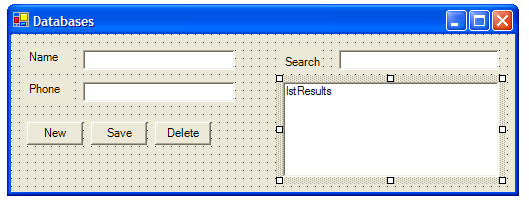
The textboxes are called txtName, txtPhone, and txtSearch. The buttons are called cmdNew, cmdSave, and cmdDelete. The listbox is called lstResults.
5. At the top of your code add these two lines. Then create an object for myAddressBook inside the constructor, Form1().
// create an array
list, it is like a vector (add/remove elements, and it auto-resizes)
private ArrayList myAddressBook;
// keeps track of the record currently being viewed
private int currentID;
public Form1()
{
InitializeComponent();
// create the address book and start it
out with 10 records
myAddressBook = new ArrayList(10);
}
6. Add a "using" statement to the very top of your code window to easily access File I/O classes:
// this contains the StreamWriter and StreamReader classes
using System.IO;
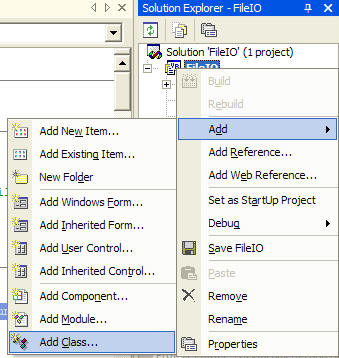
7. Create a new class named Person. Right click on your Project in the Solution Explorer and choose Add and then Add Class from the context menu. Choose the name Person.cs for your class file.
8. Our class will contain fields for a record, much like a database table. In your class, create three public fields:
public class Person
{
public int ID;
public string Name;
public string Phone;
public Person()
{
}
}
9. We'll now write three functions inside your form's code to handle the creation, updating, and deletion of records. The first will create new records, the second will update/save records, and the third will delete records. Later, we will use these in the events for our buttons. Place these three functions into your code:
private int CreateNewRecord()
{
// add a new record to our arraylist,
the function will return the ID number
// associated with the record
// create a new object of type Person
Person p = new Person();
// set the person's ID
p.ID = myAddressBook.Count;
p.Name = "";
p.Phone = "";
// stick the person in the address book
myAddressBook.Add(p);
return p.ID;
}
private void UpdateRecord(int id, string name, string phone)
{
// update a record with the given ID
number using hte Name and Phone # parameters
// find the record to update using the ID number
foreach(Person p in myAddressBook)
{
// check each
object in the address book
if (p.ID == id)
{
p.Name =
name;
p.Phone =
phone;
}
}
}
private void DeleteRecord(int id)
{
// remove a record from the array list
matching the id
Person d = new Person();
foreach(Person p in myAddressBook)
{
// check each
object in the address book
if (p.ID == id)
{
d = p;
break;
}
}
// delete the record
myAddressBook.Remove(d);
}
10. Create two functions: one to write out records to a file from memory, and one to read records from a file into memory.
private void SaveRecords()
{
// writes out the contents of the array
list to a file
// open a file for output, false = don't append
StreamWriter sw = new StreamWriter("addressbook.txt", false);
// write out record by record
foreach(Person p in myAddressBook)
{
sw.WriteLine(p.Name);
sw.WriteLine(p.Phone);
}
// close the file
sw.Close();
}
private void ReadRecords()
{
// read in all entries from the file to an
array list
// check that the file exists
if (File.Exists("addressbook.txt"))
{
// open a file for input
StreamReader sr = new
StreamReader("addressbook.txt");
// check if there are more records to
get
// peek will check the next available
character but not consume it
while(sr.Peek() != -1)
{
// create an
empty record
currentID =
CreateNewRecord();
// put the
name and phone number into the record
UpdateRecord(currentID, sr.ReadLine(), sr.ReadLine());
}
// close the file
sr.Close();
}
}
11. Double click on your
form to create a Form1_Load event. Add this code to it so you can move the
records from your file into the program's memory. We also start the program with a new empty record.
private void Form1_Load(object sender,
System.EventArgs e)
{
// load all the records into the array list from the file
ReadRecords();
// create a blank record to start with
currentID = CreateNewRecord();
}
12. Create a click event for the cmdNew button by double clicking on it. Add this code:
private void cmdNew_Click(object sender,
System.EventArgs e)
{
currentID = CreateNewRecord();
txtName.Text = "";
txtPhone.Text = "";
}
13. Create a click event for the cmdSave button by double clicking on it. Add this code:
private void cmdSave_Click(object sender,
System.EventArgs e)
{
UpdateRecord(currentID, txtName.Text, txtPhone.Text);
// write the records to the file
SaveRecords();
}
14. Create a click event for the cmdDelete button by double
clicking on it. We will leave a new empty record after we delete the
record. Add this code:
private void cmdDelete_Click(object sender, System.EventArgs e)
{
// delete the record matching the
current ID number
DeleteRecord(currentID);
// clear text boxes
txtName.Text = "";
txtPhone.Text = "";
txtSearch.Text = "";
// start with an empty record
currentID = CreateNewRecord();
// write out the records to a file
SaveRecords();
}
15. Create a TextChanged event for the txtSearch textbox so
that when someone types their keyword, the search results will update. Add
this code:
private void
txtSearch_TextChanged(object sender, System.EventArgs e)
{
// search the array list for matching records as the user
types
// clear the results list
lstResults.Items.Clear();
// make sure there is something to search for
if (txtSearch.Text != "")
{
foreach(Person p in myAddressBook)
{
// try a
partial string match, looking at the first few letters of each name only
if (p.Name !=
"")
{
if (p.Name.Substring(0, txtSearch.Text.Length) == txtSearch.Text)
{
// stick matches in the listbox
lstResults.Items.Add(p.Name);
}
}
}
}
}
16. When the user clicks on a search result, it will appear in the main
textboxes. Create a mousedown event for the lstResults listbox.
private void lstResults_MouseDown(object sender,
System.Windows.Forms.MouseEventArgs e)
{
// make sure something is actually selected in the list
if (lstResults.SelectedIndex
!= -1)
{
foreach(Person p in myAddressBook)
{
if (p.Name ==
lstResults.Items[lstResults.SelectedIndex])
{
// fill in the details on the form
txtName.Text = p.Name;
txtPhone.Text = p.Phone;
currentID = p.ID;
}
}
}
}